

WHO, WHAT, WEAR
The People, Pieces, and Places That Keep My Eye on the Prize

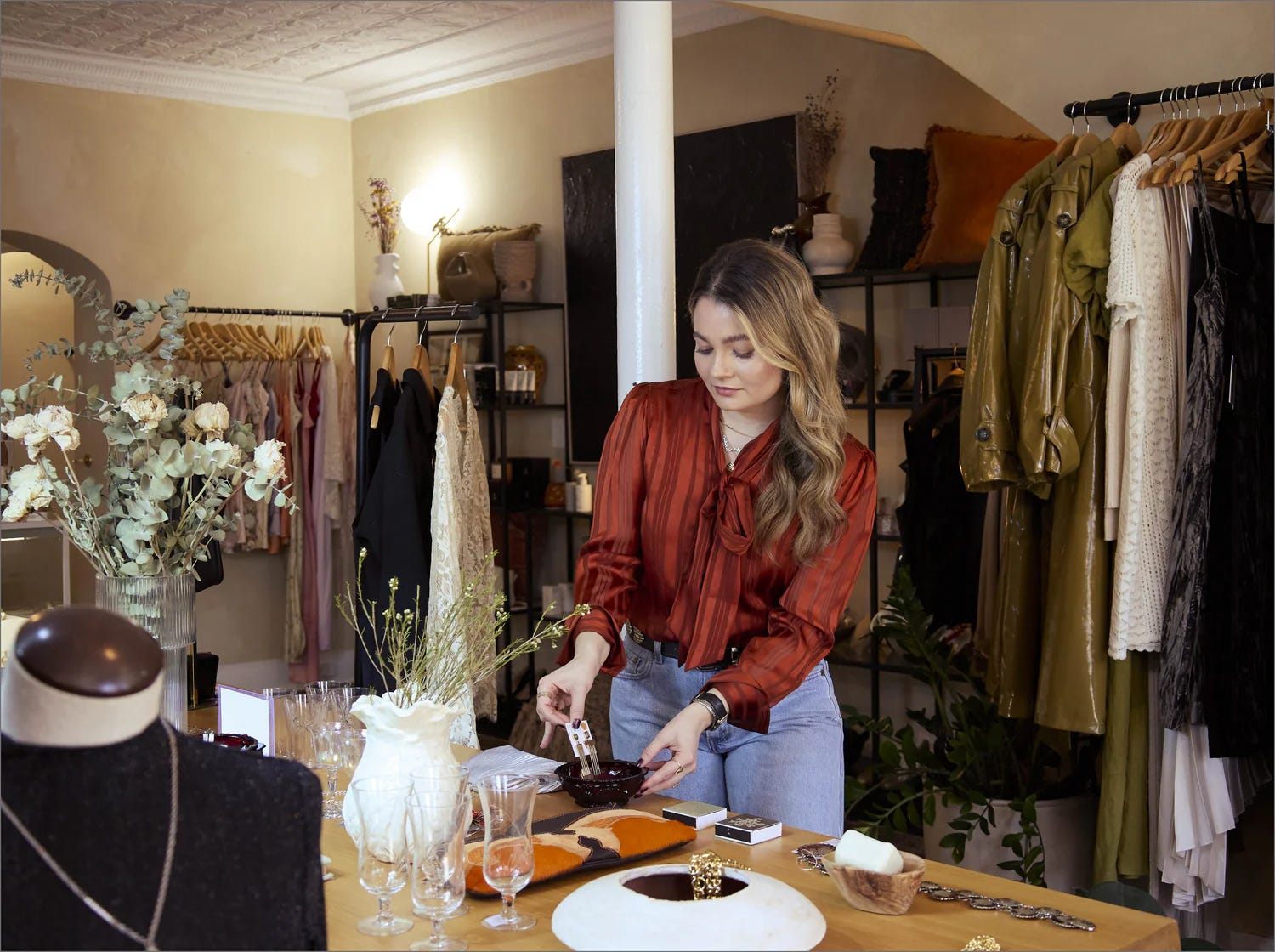
As a secondhand and vintage shop owner, I’m constantly getting asked “Where do you find everything?” followed by, “How do you decide what gets to go on the floor?” I love getting asked this question. Because as opposed to being mysteriously gatekeepy, it’s a very longwinded educational answer full of anecdotal stories and how I’ve evolved my process since starting to seriously shop secondhand and vintage nearly seven years ago.
I want to break down my answer here in more detail, because it’s a process that’s always changing but as time has gone on, I’ve created a set of standards I keep in my back pocket anytime I’m looking at an item and questioning if it fits within the Petals & Jackets ethos.
So here go…
1). Who Is She? The Women I Source For
I’m shopping for the modern woman who delights in conscious consumption, accessible luxury & elevated living.
My eye is drawn to pieces that are either a statement on their own or can tell a story layered and styled with other items. Foundational pieces like a secondhand silk brown tank top from Chicos is just as important to me as the vintage Christian Dior embroidered lace tiered skirt. Both are equal in terms of getting through the door. Because I know my client is not only shopping for her every day, she’s also shopping for that best friend’s destination wedding, that milestone birthday celebration, and the last minute RSVP she decided to say yes to. And she is not above a label. She takes ego out of the room and doesn’t judge a book by it’s secondhand department store tag.
So how do I know if a piece is worthy of fitting into this spectrum of events? It’s a level of priority in short.
2). WHAT: Fabrics, Then Function, Then Fun. These Are My Priorities- In That Order
When you’re out sourcing on your own, my first piece of advice is to always make a list of what you’re actually looking for. Take inventory on your closet before you leave and be purposeful with your goal for the day. Then put a value system together for yourself of what you will and won’t allow into your closet. Will future you be proud of you for getting that? For me, I break this down into three easy digestible guardrails that have saved me hours at the thrift and space in my closet.
Shop our latest Fall vintage & secondhand staples


#1) FABRIC: CLOTHING THAT WILL STAND THE TEST OF TIME
Natural fibers: like cotton, hemp, linen, ramie, raffia
Animal fibers: like wool, alpaca, cashmere, leather, mohair, angora
Animal secretion fibers: like silk
Keeping this value at the top of my priority list has probably saved me thousands of dollars. I can’t tell you how many times I’ve turned my nose up at pieces that looks cool from a distance but when you touch it you just know it’s not the quality you want, and it’s probably in the thrift store because someone likely wore it once and knew they’d never reach for it again. This is a really sad reality of how our world is shopping. More on THAT another time.
#2) FUNCTION: CLOTHING THAT WORKS FOR YOU
I’d say 80-90% of what I bring into the shop is function-forward, meaning more everyday wearables. But to my point earlier, I will never say no to a knock-out sequin dress or a piece that’s made of polyester.
I don’t mean to personally victimize this synthetic fabric, but polyester has a bad rep. And for some reasons, I can understand why. But on the other hand polyester is a great performance fabric. It’s lightweight, durable, and keeps you cool and dry. It resists stretching and shrinking, and maintains its shape. These are qualities that natural fibers can’t always match. Which is why I’m not opposed to bringing pieces like this into shop if it’s also made well.
I prioritize materials and construction techniques that support movement, breathability, and durability. Clothes that perform in real life and in their design. A functional piece should feel as good at the end of the day as it did when you put it on.
I look for features like:
Ease of wear: comfortable cuts that move with the body
Weather adaptability: fibers that insulate, breathe, or wick moisture depending on the need (love a vintage LL Bean raincoat amiright!?)
Longevity: well-made seams, reinforced stress points, and materials that age well
Low-maintenance care: pieces that can be spot treated are always a plus (But I do recommend getting to know your local dry cleaner for pieces that need special attention)
Pockets, closures, adjustability: the small details that make a piece not just wearable, but have utility
Whether it’s a linen shirt that keeps you cool in heat, or a wool sweater that regulates warmth without bulk, functional garments earn their place in the shop through performance, not just aesthetics.
#3) FUN: BECAUSE GIRLS JUST WANNA!
Lastly, my eye is trained and intended to find you the gems. The things you wish your mom held onto in the 70s, 80s, and 90s. That Y2K Caché beaded midi dress that was constructed to fit the female form and snatch you in all the right places.


I have a deep appreciation for the female form and I can spot a badass silhouette a mile away. The way something drapes and hangs on the body is what makes you literally glow up when you try it on. Nothing makes me giddier than someone trying on a stand-out piece and proudly walking out of the fitting room to show me. The music is on, the joy is all over the room. It’s in the bag.
My shop is meant to feel like you’re stepping into your best friend’s apartment looking for a top to borrow for the night, and I intentionally designed the interior of the shop to feel cozy and safe so you can enjoy the process of getting curious and trying new things. It’s all about finding pieces that make you feel like yourself with an elevated edge.
#3). WEAR (we love a pun!): The Places I’ve Started To Lean Into Most
Since opening the shop, I’ve become so much more knowledgable about where to source, what is and is not worth my time, and how to make the most of a town I’m passing through:
#1) PHYSICAL STORES (In order of priority)
Consignment Shops: If you want to quickly find quality pieces and are willing to pay a little bit more money than a traditional thrift store, you are going to want to hit up consignment shops in the suburbs- away from major downtown areas. Why? Cities are congested with fast fashion more often than not, in my experience. It’s a waste of my time most of the time, so I very rarely thirft in the city.
Antique Malls: If you’re looking for true vintage (50 years or more), then you will have a blast at an antique mall. Don’t get discouraged if there aren’t a lot of booths with clothing. You have to be open minded at an antique mall. If your list has jewelry and accessories for the home, you’re going to love the types of treasures you can uncover here. You will need hours of time, as most antique malls are thousands of square footage and hundreds of vendors. Get your iced coffee, find the nearest bathroom upon entering, and put on a podcast. Your anxiety will melt away. Hot tip: When you’re at the check-out counter, ask your sales associate if they have a state Antique Mall map. Most of them do. I’ve collected Illinois, Indiana, and Michigan’s maps so far and keep them in our car’s glove compartment.
Thrift Stores: I love a good thrift in an unknown town. My husband and I will typically make a day date to venture out of the city and head an hour or two into a random town and see what their local thrift has to offer. Prices are seriously cheap, but you have to be ready to look at every single piece in hopes that 1 out of every 40 pieces may yield something really cool. From a time perspective, this is usually not my favorite way to source, but it is fun when you have the right attitude and a list. My favorite thrift store chain is St. Vincent de Paul Society Thrift Store, which is nationwide. I tend to find that they are better organized and super friendly!


Shopping secondhand is incredibly important, and I love that it’s become more popular over the past decade, especially thanks to social media. It’s a trend that actually feels positive and impactful. But more than just a trend, I believe we need a real shift in the way we think about shopping. My hope is that the advice I share helps make secondhand shopping feel more personal to you. Even Pinterest launched a Thrift Shop this summer to highlight vintage style, which is such a cool step forward. I really hope it sticks!
Personal style is the core of P&J, and I know the kind of joy that comes across your face when you find a piece that feels like it was made just for you. That’s why I get out there. I source with the hope that you’ll pull something off the rack and think, “Wait… is this me?” and then try it on and realize, “This is mine.” That moment, that spark- that’s the kind of fun I live for.
Thank you for being here,
xx
Leah
It’s always so special knowing vintage pieces come with a story, but even more special knowing how much thought you put into choosing them!
I love a preview into someone's process and the vision/inspiration behind their curatorial work